
How Dust From the Sahara Desert Brings Life to the Amazon Rainforest
Imagine standing in the heart of the Amazon rainforest. The air is warm and damp. Giant trees tower above you, birds call from the canopy, and insects buzz through the thick green leaves. Life seems to burst from every corner.
Now picture the Sahara Desert, thousands of miles away. It’s a land of scorching heat, dry winds, and endless stretches of sand. At first glance, these two places couldn’t be more different.
Yet they share a surprising bond.
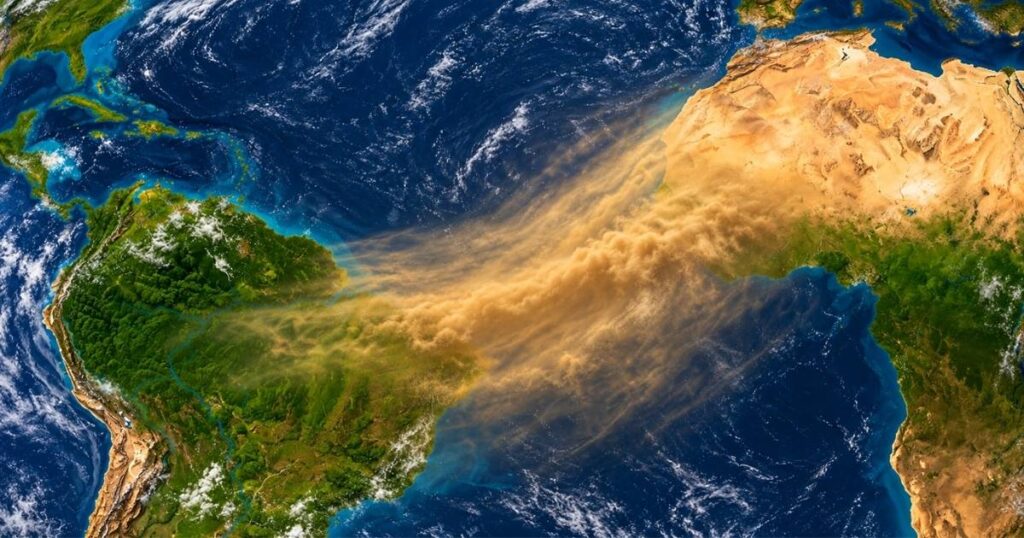
Every year, powerful winds lift millions of tons of dust from North Africa and carry it across the Atlantic Ocean. Some of that dust lands in the Amazon rainforest, bringing nutrients that help plants grow.
It’s one of nature’s most remarkable partnerships. A desert helps feed a rainforest.
And without this dusty delivery, the Amazon’s nutrient cycle would look quite different.
An unlikely connection between two continents
The Sahara is the world’s largest hot desert, covering about 3.55 million square miles (9.2 million square kilometers) of North Africa. The Amazon, meanwhile, is the largest tropical rainforest on Earth, home to an astonishing range of plants, animals, and microorganisms.
The two regions sit on opposite sides of the Atlantic Ocean, separated by roughly 3,000 miles (5,000 kilometers) along some of the dust’s travel routes.
So how can one help the other?
The answer lies in something most of us barely notice: dust.
Saharan dust contains several nutrients, including phosphorus, iron, calcium, and magnesium. When winds carry these tiny particles across the ocean, they transport valuable material from one ecosystem to another.
For the Amazon, phosphorus is especially important.
This nutrient helps plants grow, store energy, and develop healthy roots. Yet despite its lush appearance, much of the Amazon grows on soils that contain limited amounts of readily available phosphorus.
That makes the arrival of nutrient-rich dust a fascinating part of the rainforest’s survival story.
Where does all that dust come from?
Not all Saharan dust comes from rolling sand dunes.
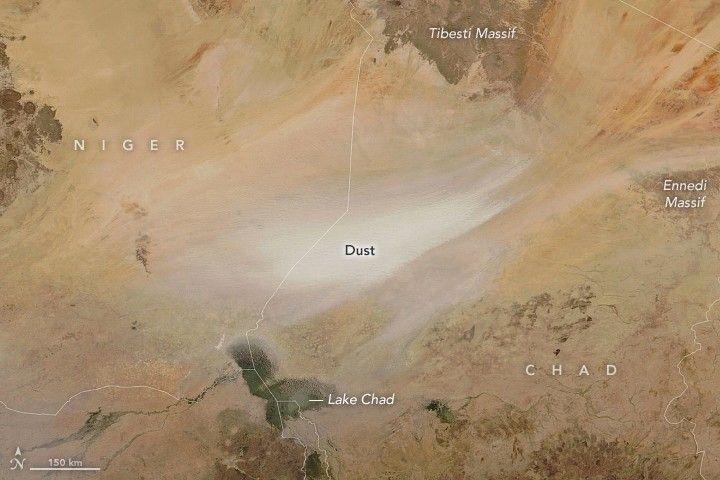
One of its most important sources is the Bodélé Depression in Chad, a dry basin that was once part of a much larger lake system.
Thousands of years ago, this region held vast amounts of water. Ancient lakes supported aquatic life, including microscopic organisms called diatoms.
Diatoms build tiny shells from silica. When they die, their remains can settle on lakebeds. Over time, these deposits become fine, powdery sediment.
As the ancient lakes dried up, they left behind huge areas of exposed material.
Today, strong winds sweep across the Bodélé Depression, lifting fine particles high into the atmosphere.
The area’s geography makes this process even more powerful. Winds can funnel between nearby highlands, gaining speed as they cross the dry basin.
The result is an enormous natural dust source.
Scientists have identified the Bodélé Depression as a major contributor to the dust that travels from Africa toward the Atlantic.
There’s something rather poetic about it. Material left behind by ancient aquatic life can eventually help support a modern tropical rainforest.
How does desert dust cross an entire ocean?
You might wonder how something as small as dust can travel thousands of kilometers without falling to the ground.
The secret is particle size, wind, and atmospheric circulation.
Large grains of sand are heavy. They usually fall back to Earth close to where they started. Fine dust particles, however, can remain suspended in the air for days.
When strong winds lift them high enough, major air currents can carry them far beyond the desert.
One important pathway is the Saharan Air Layer, a mass of warm, dry, dusty air that often moves westward over the tropical Atlantic.
This layer can extend several kilometers above the ocean.
Once dust enters these air currents, it begins an extraordinary journey.
Some particles fall into the ocean. Others are washed out of the air by rain. A portion continues toward South America, where it can settle on leaves, rivers, and soil.
This process happens on a scale that’s difficult to imagine.
And thanks to modern satellites, scientists can watch it unfold.
NASA discovered just how much dust makes the trip
For years, researchers knew that Saharan dust reached the Amazon. What they didn’t fully understand was how much material made the journey.
NASA helped answer that question using the Cloud-Aerosol Lidar and Infrared Pathfinder Satellite Observation satellite, better known as CALIPSO.
Launched in 2006, CALIPSO used a laser-based instrument called lidar to study particles and clouds in the atmosphere.
Unlike a normal camera, lidar sends pulses of light toward Earth and measures the light that scatters back. This helps scientists study the height and structure of dust layers.
In a study published in Geophysical Research Letters in 2015, researchers analyzed satellite observations collected from 2007 to 2013.
Their findings were remarkable.
The study estimated that roughly 22,000 metric tons of phosphorus reached the Amazon basin each year in Saharan dust.
That’s a substantial amount of plant nutrition delivered through the sky.
The figures vary from year to year, depending on weather, rainfall, and dust conditions in Africa.
Still, the message is clear: the movement of dust between continents is a major natural process, not a rare accident.
Why does the Amazon need nutrients from a desert?
The rainforest looks incredibly fertile, but many of its soils are old, weathered, and poor in certain nutrients.
How can such a rich forest grow on nutrient-poor ground?
Much of the answer lies in recycling.
In warm, wet tropical forests, dead leaves, branches, and other organic matter break down quickly. Fungi, bacteria, insects, and other organisms release nutrients from this material.
Plants then absorb those nutrients through their roots, often with help from fungi living in close contact with them.
It’s an efficient system.
But nutrients don’t stay in the forest forever.
Heavy rainfall can wash dissolved nutrients through the soil and into rivers. This process, called leaching, is especially important in tropical regions where rain is frequent.
Phosphorus presents another challenge. It can become bound to soil minerals, making it difficult for plants to absorb.
So even though the Amazon recycles nutrients with impressive efficiency, outside sources can help replace what the ecosystem loses.
That’s where Saharan dust enters the picture.
It provides a fresh supply of minerals, including phosphorus, that can become part of the forest’s nutrient cycle.
The dust doesn’t act like a bag of fertilizer poured straight onto plant roots. Some nutrients are more available than others, and soil chemistry affects how plants can use them.
But over long periods, these inputs can help maintain the balance of nutrients in parts of the rainforest.
Phosphorus: the tiny nutrient with a huge job
Phosphorus may not sound exciting, but it’s a key part of DNA and RNA, the molecules that store and help express genetic information.
It’s also found in ATP, a molecule that cells use to transfer energy.
Whenever a plant grows a new leaf, builds roots, or produces seeds, phosphorus plays a role.
Without enough of it, plant growth can slow.
In many tropical soils, phosphorus is one of the nutrients that limits growth. That doesn’t mean every part of the Amazon is short of it. The basin contains many soil types, and nutrient conditions vary widely.
Floodplains, for example, can receive fresh sediments from rivers. Other areas depend more heavily on nutrients already stored in the forest and soil.
Saharan dust is one part of this larger nutrient story.
Scientists have found that the estimated phosphorus carried into the Amazon by Saharan dust is comparable in scale to some estimates of phosphorus lost through rainfall-driven processes.
That suggests dust may help replace a meaningful share of the phosphorus leaving the ecosystem.
It’s an impressive natural exchange, even if the exact balance remains uncertain.
The Atlantic Ocean gets a share, too
The Amazon isn’t the only ecosystem that receives nutrients from Saharan dust. As dust travels west, much of it settles into the Atlantic Ocean.
And that matters for marine life.
Tiny organisms called phytoplankton float near the ocean’s surface. Like plants on land, many use sunlight to produce energy-rich organic matter through photosynthesis.
These microscopic organisms form the base of many marine food webs, and they also need nutrients to grow.
In some ocean regions, iron is scarce enough to limit the growth of certain phytoplankton. Dust can supply iron and other elements, although the amount that marine organisms can absorb depends on the dust’s chemistry and local ocean conditions.
This means that a dust storm over North Africa may influence biological activity far out at sea.
The effects aren’t always simple. More dust doesn’t guarantee more plankton, and different marine regions respond in different ways.
Still, it’s another example of how the atmosphere connects distant ecosystems.
Is Saharan dust always a good thing?
Not quite.
The same dust that carries useful nutrients can also cause problems.
When large Saharan dust clouds reach the Caribbean, parts of South America, or the southern United States, they can reduce visibility and affect air quality.
Fine particles can irritate the lungs and worsen symptoms for people with asthma or other breathing conditions.
Dust can also affect weather by changing how sunlight moves through the atmosphere. It may influence cloud formation and rainfall, though these effects depend on many factors.
There are ecological concerns as well.
Scientists have studied whether dust can carry microorganisms, including some that may affect plants, animals, or marine ecosystems. The risks vary, and finding microbes in dust doesn’t automatically mean they cause disease.
So Saharan dust isn’t simply good or bad.
Its effects depend on where it travels, what it carries, and how much arrives.
What happens when the dust supply changes?
The amount of dust crossing the Atlantic isn’t constant. Some years bring huge dust plumes. Others bring far less.
Rainfall patterns, wind strength, vegetation cover, and soil moisture all affect how much dust rises from North Africa.
When the Sahel, the region south of the Sahara, becomes wetter, some dust-producing surfaces may become less exposed. Changes in wind patterns can also affect how much dust reaches the ocean.
Climate change adds another layer of uncertainty.
Scientists are studying how future shifts in rainfall, temperature, winds, and land use might alter Saharan dust emissions.
There isn’t one simple answer.
Some changes could reduce dust production in certain regions, while others could increase it. Dust transport models also contain uncertainties.
For the Amazon, any long-term change in nutrient delivery could matter, especially when combined with deforestation, fires, drought, and rising temperatures.
But it’s important not to overstate the connection.
A reduction in Saharan dust wouldn’t mean the Amazon would suddenly stop growing. The rainforest receives nutrients from several sources and maintains large internal nutrient cycles.
Dust is a supporting part of the system, not its only lifeline.
Even so, changes in that support could affect the forest over time.
The desert and the rainforest are more connected than they look
Next time you picture the Amazon, think beyond its giant trees, colorful birds, and winding rivers.
Imagine the tiny particles drifting down from the sky.
Some began their journey in an ancient lakebed in the Sahara. They rose with the wind, crossed an ocean, and eventually settled in one of the greenest places on Earth.
Along the way, they carried minerals that can help nourish plants and support natural nutrient cycles.
It’s a remarkable thought: one of the driest regions on the planet helps supply nutrients to one of the wettest.
The Amazon’s survival depends on far more than Saharan dust, of course. Rainfall, healthy soils, biodiversity, and the forest’s own recycling systems all play vital roles.
But the dust adds an unexpected chapter to the story.
It shows that life on Earth is connected in ways we rarely see.
Sometimes, the smallest particles travel the greatest distances. And sometimes, a desert helps keep a rainforest green.