The Wandering Palm: How Coconuts Traveled the World
Coconut palms feel ancient, like they’ve always belonged to coastlines. But their story isn’t rooted in one place. It’s a story of drifting oceans, human migration, and a fruit that seems almost designed to travel.
Let’s trace that journey. It’s a lot stranger (and more fascinating) than it first appears.
Not just one origin story
Here’s the twist right away: coconuts don’t have a single, tidy birthplace.
Scientists generally agree on two main centers of origin:
- The Indo-Pacific region (think Southeast Asia, Indonesia, the Philippines)
- The Indian Ocean region, possibly including coastal South Asia
For a long time, researchers argued over which came first. But newer genetic studies suggest a more nuanced picture. There are actually two distinct genetic lineages of coconuts, almost like cousins that grew up in different neighborhoods.
One group likely emerged in Southeast Asia. The other may have formed around the Indian Ocean basin.
And at some point, those lineages met, mingled, and spread.
It’s a bit like tracing human ancestry—messy, overlapping, and full of unexpected connections.
Built for the ocean
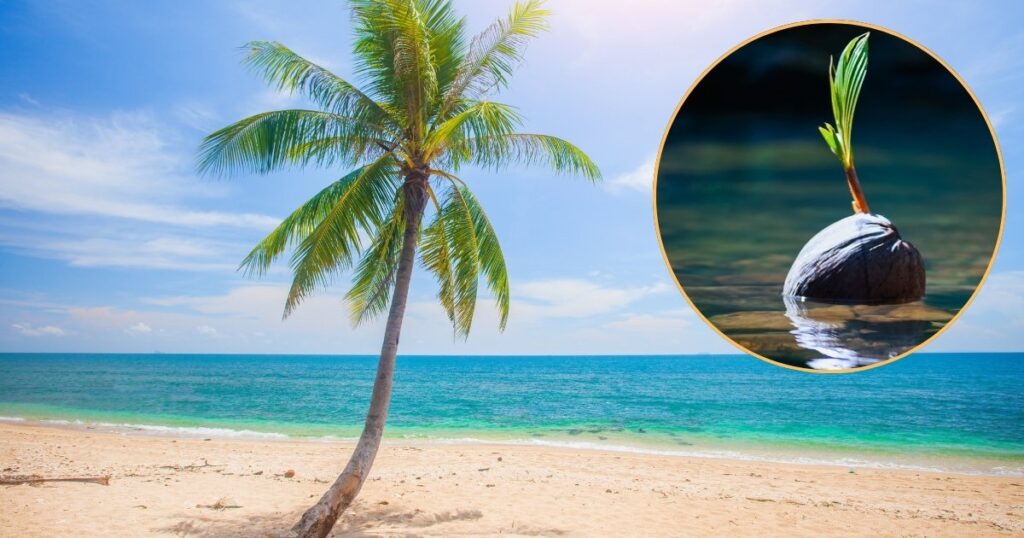
Coconuts are practically natural flotation devices.
Think about their structure:
- A tough outer husk that traps air
- A waterproof inner shell
- Nutrient-rich flesh and liquid inside
This isn’t accidental. It’s a survival strategy.
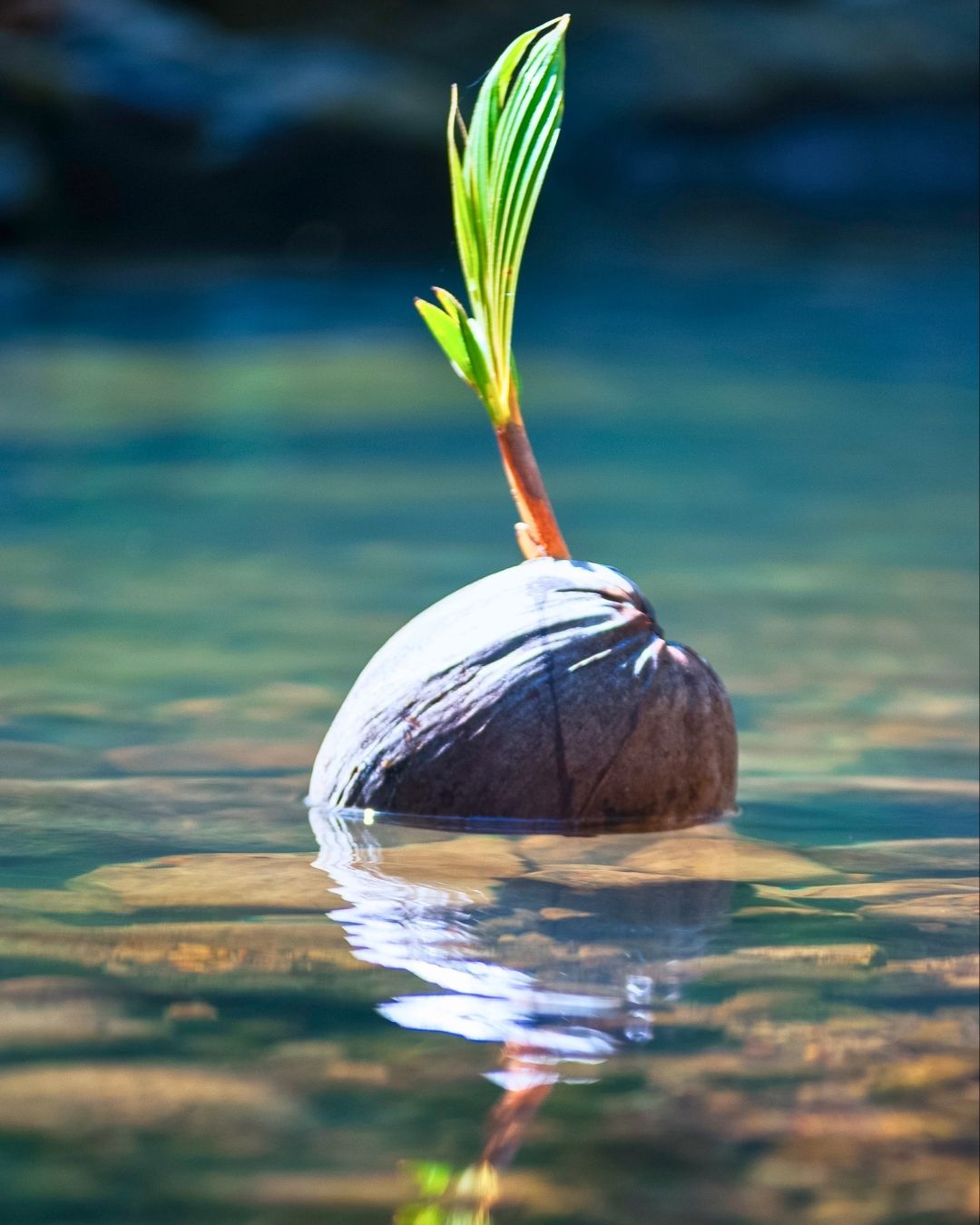
A coconut can float in seawater for weeks, even months, without losing viability. When it finally washes ashore, it’s ready to sprout.
That’s rare. Most seeds would rot, sink, or get eaten long before making landfall.
So even before humans got involved, coconuts were already traveling across oceans like tiny, self-contained life capsules.
Ocean currents as quiet architects
Picture the ancient oceans full of slow, steady currents flowing like invisible highways.
These currents played a major role in the distribution of coconuts.
In the Indo-Pacific, prevailing currents could carry coconuts:
- From Southeast Asia toward India and Sri Lanka
- Across the Pacific toward Polynesia
- Along coastal routes in Africa
Even a single successful landing (one coconut sprouting on a new shore) can start a new population.
Over centuries, these slow drifts added up.
Coastlines began to change. Palms appeared where none had been before.
Then humans entered the story
If ocean currents were the first chapter, humans wrote the rest.
Early seafarers (especially Austronesian peoples) were extraordinary navigators. Thousands of years ago, they were already crossing vast stretches of ocean in outrigger canoes.
And they carried coconuts with them.
Why? Well, coconuts are almost absurdly useful:
- Fresh water inside (sterile and drinkable)
- High-calorie food
- Oil for cooking and light
- Fibers for rope and mats
- Shells for tools and containers
In other words, coconuts were survival kits.
So when these voyagers moved from island to island through Indonesia, into the Pacific, and toward places like Hawaii and Madagascar, they brought coconuts along.
This wasn’t random drift anymore. It was an intentional spread.
A quick detour: Madagascar’s curious connection
Madagascar sits off the coast of Africa. You’d expect its plant life to reflect African origins.
But coconuts there tell a different story.
Genetic evidence shows strong links between Malagasy coconuts and those from Southeast Asia, not Africa.
How did that happen?
Human migration.
Around 1,500 years ago, Austronesian sailors reached Madagascar, crossing the Indian Ocean. They brought crops, language elements, and coconuts.
It’s one of those moments where botany quietly confirms history.
The role of selection (and human taste)
As coconuts spread, they didn’t stay exactly the same.
Humans began selecting for traits they preferred. Over time, this led to noticeable differences between coconut types.
Two broad categories emerged:
- Tall varieties: Hardy, cross-pollinating, long-lived
- Dwarf varieties: Shorter, often self-pollinating, quicker to fruit
Dwarf coconuts, in particular, show strong signs of human selection. They’re easier to harvest, more predictable, and often have sweeter water.
So while the earliest coconuts spread naturally, later populations were shaped by human choices in what people planted, what they favored, and what they carried forward.
It’s agriculture, but on a global, ocean-spanning scale.
Crossing the Atlantic (and a bit of confusion)
Now we get to a long-standing puzzle.
How did coconuts appear in the Americas?
There are two main possibilities:
- Natural drift across the Pacific
- Human introduction after European exploration
For a while, the first idea had some traction. After all, coconuts float, right?
But genetic studies suggest most coconuts in the Americas today trace back to post-15th-century introductions, likely brought by European ships.
Portuguese and Spanish traders carried coconuts:
- From Africa to Brazil
- Across colonial trade routes
- Into the Caribbean and Central American regions
So while it’s possible that some coconuts arrived earlier by sea, the widespread populations we see today are largely tied to human trade.
Why coconuts love the tropics (and refuse to leave)
You’ll notice something consistent: coconuts stick to warm coastal areas.
That’s not just preference, it’s a necessity.
Coconut palms need:
- Warm temperatures year-round
- Plenty of sunlight
- Sandy, well-drained soil
- Access to groundwater or rainfall
They’re also salt-tolerant, which gives them an edge along coastlines.
But they don’t handle cold well. Even a light frost can damage them.
So while coconuts have traveled far, they’ve stayed within a fairly narrow band around the equator.
A fruit that shaped cultures
At this point, it’s hard to separate coconuts from the cultures they’ve touched.
Across the tropics, coconuts aren’t just food; they’re woven into daily life.
In different regions, they serve different roles:
- In South Asia: cooking oil, religious offerings
- In Southeast Asia: desserts, curries, fermented drinks
- In the Pacific Islands: building materials, traditional medicine
- In the Caribbean: beverages, sweets, and street food
There’s even a nickname you’ll hear often: “the tree of life.”
It’s not an exaggeration. Few plants offer such a wide range of uses, from root to leaf.
The science keeps evolving
Even now, researchers are still piecing together the coconut’s journey.
Genomic studies are revealing:
- Migration patterns that weren’t obvious before
- Evidence of ancient hybridization between lineages
- Clues about how climate and human movement shaped distribution
It’s a reminder that something as familiar as a coconut can still hold unanswered questions.
And that’s kind of refreshing, honestly.