
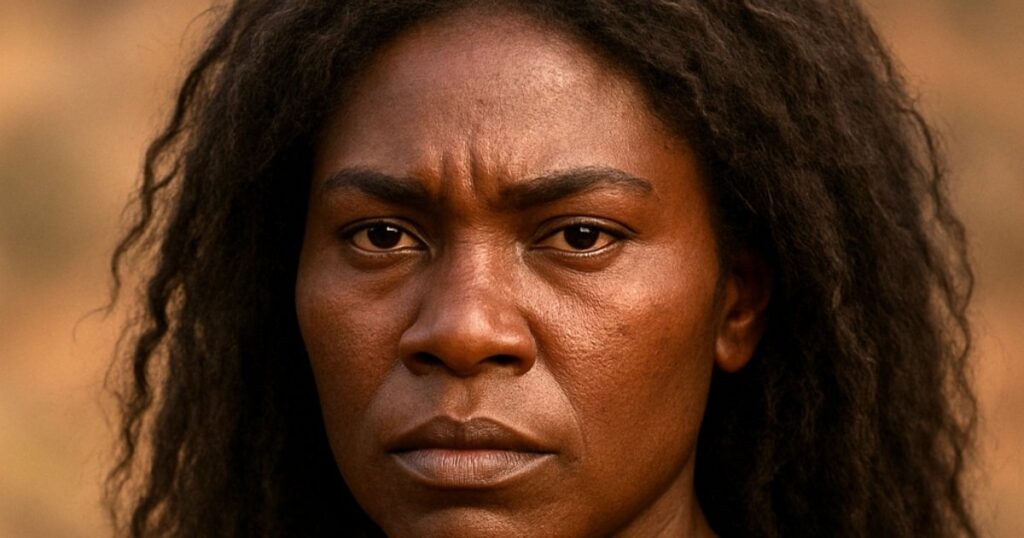
The Mother of Us All: Tracing the Legacy of Mitochondrial Eve
If you’ve ever stared at your reflection and wondered where your face came from (your mother’s eyes, your grandmother’s smile), you’re already chasing a ghost much older than family albums.
Somewhere nearly two hundred thousand years ago, lived a woman whose mitochondrial DNA quietly carried forward through every generation. Scientists call her Mitochondrial Eve.
She wasn’t a queen or a goddess. She didn’t even know she was extraordinary. She was, most likely, an ordinary woman. Yet, through an unbroken maternal line, a piece of her exists in every living human today.
That’s not poetic exaggeration. It’s a molecular fact.
What’s hiding inside your cells
Inside nearly every cell of your body, there’s a small, bean-shaped organelle called the mitochondrion. It’s often nicknamed the cell’s “powerhouse,” but that label barely does justice.
Each mitochondrion produces energy by turning oxygen and nutrients into ATP, the fuel that keeps us alive.
But mitochondria have a secret life. They carry their own DNA—tiny, circular strands passed only from mother to child.
Unlike nuclear DNA, which comes half from your mom and half from your dad, mitochondrial DNA (or mtDNA) is a purely maternal inheritance. It doesn’t mix or shuffle during reproduction; it just copies itself, generation after generation, like a biological whisper from your foremothers.
If that sounds oddly intimate, that’s because it is. Every one of us, whether in Seoul, Nairobi, or San Francisco, carries the same faint molecular trace that originated in one woman’s body hundreds of millennia ago.
How scientists traced the mitochondrial breadcrumb trail
Before we meet Mitochondrial Eve herself, it is helpful to understand how she was discovered. Not with bones or artifacts, but with chemistry and clever math.
The story began in the early 1980s, when geneticists were learning to read the language of DNA with greater precision. At the University of California, Berkeley, researchers Rebecca Cann, Mark Stoneking, and Allan Wilson collected blood samples from people across the world, including African, European, Asian, Indigenous Australian, and Native American populations, among others.
They focused not on the nuclear DNA (the kind we usually think of) but on mitochondrial DNA, a small ring of genes found outside the cell’s nucleus. Here’s the genius part: because mtDNA comes only from mothers and doesn’t mix with paternal genes, it’s like a clean thread of maternal inheritance that can be followed backward through generations.
Each time mtDNA is copied, it can pick up tiny random mutations—little spelling errors in the genetic text. These errors don’t usually affect health, but they serve as time markers. By comparing the number and type of mutations between people from different regions, scientists can estimate how long ago their common ancestor lived.
When the Berkeley team conducted their analysis, all the mitochondrial sequences traced back to a single ancestral source, a woman who lived approximately 150,000 to 200,000 years ago, most likely in Africa.
It wasn’t that she was the only woman alive then, but that her mitochondrial lineage is the only one still unbroken today. Other women’s lines simply ended when they had only sons or when their daughters’ descendants didn’t survive.
This discovery was revolutionary. It revealed that all modern humans share a common maternal ancestor, and it provided genetic confirmation of something anthropologists had long suspected: our species originated in Africa.
Of course, not everyone accepted it right away. Some argued that relying on a single genetic marker oversimplified human history. But as DNA technology advanced and more data from nuclear and Y-chromosomal DNA became available, the evidence continued to converge on the same conclusion.
Today, dozens of independent studies have refined the details but confirmed the core truth: every human being alive is descended from a single population of African ancestors, and through our mitochondria, we all share a maternal thread that stretches back nearly 200,000 years.
Where might Mitochondrial Eve have lived
So where did she call home? Genetic evidence points strongly to eastern or southern Africa. Picture wide grasslands punctuated by thorn trees, river valleys teeming with wildlife, and early humans moving in small, nomadic groups.
Eve likely lived among them. Not as an isolated figure but as part of a community that hunted, gathered, and raised children together. Daily life was probably raw but rhythmic: collecting tubers, cracking nuts, weaving shelters, watching the sun move across the savannah.
It’s humbling to think that her world was both fragile and fierce. Every sunrise meant survival wasn’t guaranteed. Yet somehow, her daughters endured.
It’s tempting to romanticize her, but Mitochondrial Eve didn’t know she’d be “the one.” She lived and died like anyone else of her time. It’s the sheer mathematical chance of inheritance (plus millennia of resilience) that carried her mitochondrial blueprint through every woman since.
Mitochondria and modern health
Mitochondria aren’t just evolutionary relics—they’re crucial to how our bodies function today.
When mitochondria falter, our energy systems collapse. Scientists link mitochondrial dysfunction to aging, muscle weakness, neurodegenerative diseases, and infertility.
There’s even cutting-edge research exploring mitochondrial replacement therapy—sometimes dubbed the “three-parent baby.” Here, doctors transfer healthy mitochondria from a donor egg into a mother’s egg to prevent genetic disorders. The child still carries the parents’ nuclear DNA but inherits mitochondria from a third woman. It’s controversial, of course, but it also shows how our understanding of inheritance continues to evolve.
For anyone fascinated by the intersection of biology, technology, and ethics, mitochondria are the quiet epicenter of some of the most profound medical debates of our time.
The poetry of connection
We talk a lot about how divided people are. Yet, genetically speaking, we’re astonishingly close. If you trace the maternal line back far enough, you find one woman. One heartbeat that rippled outward until it filled the planet.
Every breath you take, every cell pulsing with energy, carries her gift. You’re part of her story, just as she’s part of yours.
And maybe that’s the quiet lesson Mitochondrial Eve leaves us: we’re not separate threads, but one vast tapestry, still being woven by the hands of time.


